
Call for Industry Talks & Exhibitions
Key dates:
- Submission Deadline:
March 31stApril 15th, 2026 - Decision Notification:
April 13thApril 30th, 2026 - Camera Ready Submission:
April 30thMay 8th, 2026
All deadlines are at 23:59 Anywhere on Earth
Selection: Curated
Format & Timing:
- Industry Talks: 10 minutes (+ 5 minutes for questions & interaction)
- Exhibition/Demo
Please submit your workshop proposal to the Industry Chairs at: industry@imx.acm.org
Industry at IMX 2026
The Industry Track at IMX 2026 is a leading venue to showcase your organization’s significant advances in immersive media research, development, technology, and real-world implementation. We invite stand-out contributions for both Industry Talks and Exhibitions/Demos to foster interaction and expand networking opportunities. Our goal is to host a dynamic discussion on the future of immersive media, highlighting recent industry developments and the key challenges that require attention from the broader research community. Join us to provoke discussion, network, and collaborate with conference delegates. We welcome contributions (presentations, demos, or exhibitions) across all topics relevant to IMX. For inspiration, please see the following non-exhaustive list:
We welcome contributions on the use of artificial intelligence and machine learning techniques applied to immersive media experience at large. Areas of interest include, but are not limited to, the use/development of AI/ML to: enable novel media experiences, enhance production tools and workflows, support crowd-sourcing and collective intelligence in rich media systems, media analysis and information diffusion, predict real-world events, monitor media bias, misinformation, and fake news.
This topic is suitable for contributions whose primary contribution is the introduction of novel ways of experiencing interactive media content. That includes new forms of media content (e.g., VR, AR, MR, XR, 360°, live-streaming, etc.) consumed in diverse ways, including across multiple screens, platforms, and in immersive theatres. Application areas include entertainment and information, including interactive and generative documentaries, transmedia storytelling, volumetric filmmaking, live performance broadcasts, and object-based media productions. Papers in other application areas, such as education, healthcare, well-being, governance, and decision-making, are also welcome.
This topic focuses on advances in audience engagement with media content as a rapidly evolving activity across diverse platforms, devices, and timeframes. It welcomes contributions that seek to understand audiences using a rich variety of analytic approaches, including sensing audiences, sentiment analysis, and measuring and monitoring the quality of experience. Areas of interest include (but are not limited to) consumption trends and behaviors in young audiences, sharing practices and communication strategies, identifying engagement patterns across diverse genres, platforms, and demographics, scheduled versus on-demand content consumption, binge viewing, and multi-platform engagement.
This topic focuses on technologies, systems, and interfaces that improve and advance our interactions with media content online, at home, or on the move. It encourages submissions describing technical advancements in streaming systems, content synchronization for multi-platform delivery, and recommendation and companion apps. Additional areas for consideration include game engines for content delivery, location-based and context-aware applications and services, and object-based media.
This topic solicits papers describing procedural advances in the preparation, design, and development of media experiences. Areas of interest include new production processes for TV, online video, VR, AR, XR, and 360° formats. Novel tools and workflows using motion capture, volumetric capture, and animation are encouraged, as are the presentations of innovative authoring and data-driven tools for interactive or multi-platform content development. In particular, the applicability and impact of Generative AI in production tools and workflows are also part of this topic. In addition to papers describing technical innovations, this topic area is also interested in innovations from design and humanities perspectives detailing the authoring process for writing interactive content and the human-centered design methods used to realize these narratives.
This topic focuses on the new business, marketing, purchasing, subscription, and monetising strategies encountered in the new media landscape of TV and online video. Areas of interest include (but are not limited to) targeted advertisements, freemium products, programmatic media buying, in-programme recommendations and purchases, exploiting consumption data, monetising second-screen experiences, and social media influencer strategies.
The impact of the new interactive media and TV landscape on culture and society is powerful and raises many important and challenging topics for consideration. This area welcomes papers from a wide variety of theoretical and analytical perspectives examining structured reality TV, social media manipulation and targeting, media convergence and platform monopolies, intellectual property, remix culture, fan culture, media activism and participation politics, or tactical media practices. In addition, research concerning media violence, social media addiction, or issues of bias and ethics would also be appropriate for this topic.
This topic focuses on disruptive media practices that challenge traditional media consumption patterns and expand spectator experiences. Authors are invited to describe the design, development of (and response to) constructed media-centric work or speculate about future-oriented media provocations.
Format for Industry Talk or Exhibition Proposals
In order to keep the evaluation process fair and lightweight, we ask that IMX-in-Industry submissions be submitted using the following PowerPoint template:
Please use this as a guidance on how to tell a story. If your submission falls into the format more like a panel, exhibition or demo, feel free to adapt the template to suit your needs. However, we would like to see the following sub-topics covered.
- Title page
- Company Name & Introduction
- The Problem and/or Opportunity & Current Solutions (define the real problem/need you’re solving, and for who), the topic you are addressing
- For a demo or exhibition – what type of dissemination materials (If any) will provided
- The Challenge (practical issues associated with your relevant topic) or in case of a demo (what it is, what’s the novelty and impact)
- Product/Service/Application (what you did, what you offer or plan to offer)
- Impact & What’s next: what it means, the potential impact, how others might use the findings, implications for practice, next steps.
For Demos/Exhibition, please include your potential needs such as electricity power, cables space, tables and chairs, poster board, screens…
We encourage, but do not require, authors to use video to help tell the story. That way, in case anything goes wrong, we (and you) will have a backup plan!
At the conference
Accepted proposals for talks will be presented in the form of industry talks with a duration of 10 minutes + 5 minutes for questions & interaction, using the submitted presentation as a basis.
As an Industry agent or practitioner, you will be offered the opportunity to have a demo for exhibitions, demos and networking during the conference 9-11 June, 2026.
After the conference
Your accepted presentation slides will be published in the conference adjunct proceedings (e.g. Figshare), not indexed in the ACM Digital Library.
Talk, Demo, or Both
You can choose between applying for both an Industry talk and a demo, or just for a talk or a demo. Industry talks and exhibitions will happen during the same day, but will not overlap in time.
Registration
The acceptance of an Industry talk and/or Exhibition Demo will require the registration of at least one of the representatives of the company / organization.
Become a sponsor?
The interested companies / organizations will also have the opportunity to become a sponsor of the conference. Some of them include the registration to the conference! Contact our general chairs for more details: general@imx.acm.org.
ACM's Publication Policy
- “By submitting your article to an ACM Publication, you are hereby acknowledging that you and your co-authors are subject to all ACM Publications Policies, including ACM’s new Publications Policy on Research Involving Human Participants and Subjects. Alleged violations of this policy or any ACM Publications Policy will be investigated by ACM and may result in a full retraction of your paper, in addition to other potential penalties, as per ACM Publications Policy.” https://www.acm.org/publications/policies/research-involving-human-participants-and-subjects
- “Please ensure that you and your co-authors obtain an ORCID ID, so you can complete the publishing process for your accepted paper. ACM has been involved in ORCID from the start and we have recently made a commitment to collect ORCID IDs from all of our published authors. We are committed to improve author discoverability, ensure proper attribution and contribute to ongoing community efforts around name normalization; your ORCID ID will help in these efforts.”
Industry Chairs
For further details on scope, submission route or any other issues, please get in touch with the Industry Chairs at: industry@imx.acm.org

Roberto Azevedo
Disney Research | Studios
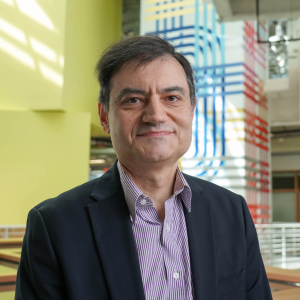
Ioannis Katsavounidis
Meta

Vinoba Vinayagamoorthy
IMX SC